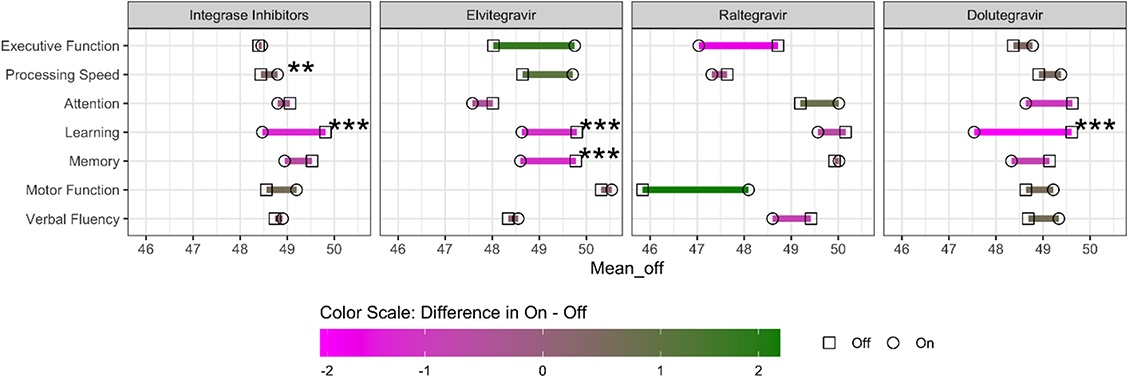
Background: Integrase strand transfer inhibitors(INSTIs) are first-line regimens for HIV treatment. We aimed to examine their impact on cognitive performance and depressive symptoms in women with HIV(WWH). Setting: Women’s Interagency HIV Study(WIHS) a multisite, prospective, cohort study Methods: WWH who started or switched to INSTI-based ART and completed neuropsychological(NP) testing and the Center for Epidemiological Studies-Depression(CES-D) scale before and after INSTI start/switch were included in the analyses. Primary outcomes were demographically corrected cognitive domain T-scores. Linear mixed effects models adjusted for relevant covariates were used to examine effects of start/switch of any INSTI and individual INSTI drugs on cognition and CES-D. Results: 639 WWH, median age 49(interquartile range 12) years, 66% Black non-Hispanic, had NP and CES-D data before and after INSTI start/switch. While 14% started INSTI-based ART, the remainder switched to INSTI-based ART from another regimen. Overall, any INSTI use was associated with poorer learning post-INSTI. Specifically, use of elvitegravir, but not raltegravir, was associated with poorer learning. In analyses restricted to INSTI switch, any INSTI use, and specifically dolutegravir use, was associated with poorer learning. Among those switching from a PI-based regimen, INSTIs overall and dolutegravir remained associated with poorer learning; switching from an NNRTI to dolutegravir was also associated with poorer learning. INSTI start/ switch was not related to depressive symptom changes. Conclusions: INSTI use was associated with poorer learning among WWH. These changes were mainly observed in elvitegravir and dolutegravir users, indicating that the impact of INSTI on cognition in WWH may not be a class effect.
Publication
Integrase strand transfer inhibitor start or switch impacts learning in women with HIV
Abstract