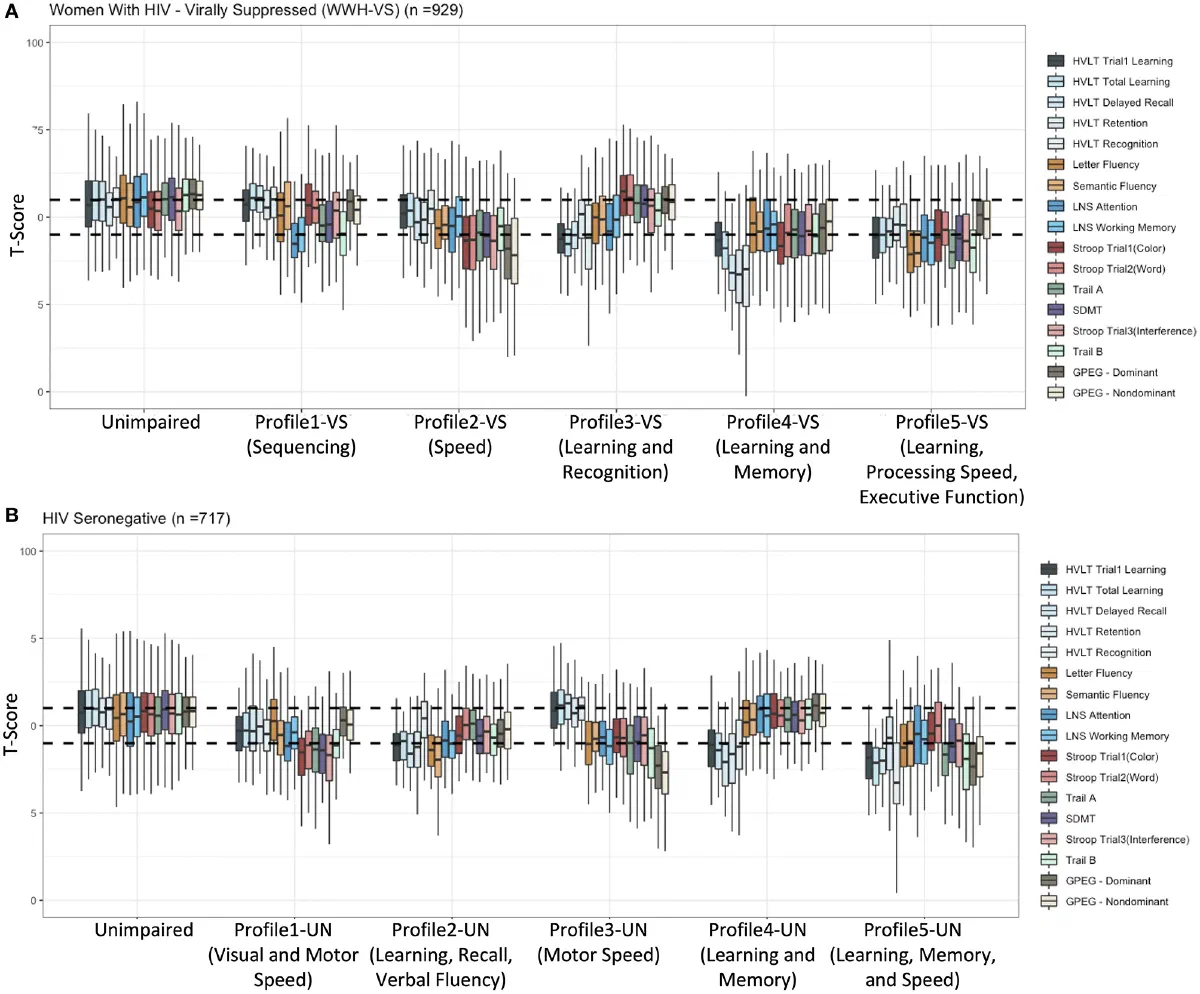
This paper is central to the computational phenotyping arc because it focuses specifically on women with HIV, a group often underrepresented in mixed-sex neuroHIV analyses. It shows that viral suppression does not eliminate cognitive heterogeneity, and that women’s cognitive profiles can be organized into interpretable patterns rather than treated as a single impairment category. The work also demonstrates how machine learning can surface modifiable or clinically meaningful correlates of profile membership.
- The study analyzed neuropsychological data from 929 virally suppressed women with HIV and 717 women without HIV from the Women’s Interagency HIV Study.
- Seventeen neuropsychological performance metrics were used to identify high-dimensional cognitive patterns.
- Among virally suppressed women with HIV, the analysis identified an unimpaired group plus profiles involving sequencing, processing speed, learning and recognition, and learning and memory weaknesses.
- Random forest models were used to identify sociodemographic, behavioral, clinical, and female-specific factors associated with cognitive profile membership.
- The findings emphasize profile heterogeneity and point toward potentially modifiable factors that may contribute to impaired cognitive patterns.
This study looked for patterns in cognitive test performance among women with HIV whose virus was suppressed. Instead of asking only whether cognition was impaired, the analysis identified different kinds of cognitive profiles. That makes the findings more useful for understanding why cognitive difficulties vary across individuals and which risk factors may matter for each pattern.
Cognitive impairment remains frequent and heterogeneous in presentation and severity among virally suppressed (VS) women with HIV (WWH). We identified cognitive profiles among 929 VS-WWH and 717 HIV-uninfected women from 11 Women's Interagency HIV Study sites at their first neuropsychological (NP) test battery completion comprised of: Hopkins Verbal Learning Test-Revised, Trail Making, Symbol Digit Modalities, Grooved Pegboard, Stroop, Letter/Animal Fluency, and Letter-Number Sequencing. Using 17 NP performance metrics (T-scores), we used Kohonen self-organizing maps to identify patterns of high-dimensional data by mapping participants to similar nodes based on T-scores and clustering those nodes. Among VS-WWH, nine clusters were identified (entropy = 0.990) with four having average T-scores ≥45 for all metrics and thus combined into an “unimpaired” profile (n = 311). Impaired profiles consisted of weaknesses in: (1) sequencing (Profile-1; n = 129), (2) speed (Profile-2; n = 144), (3) learning + recognition (Profile-3; n = 137), (4) learning + memory (Profile-4; n = 86), and (5) learning + processing speed + attention + executive function (Profile-5; n = 122). Sociodemographic, behavioral, and clinical variables differentiated profile membership using Random Forest models. The top 10 variables distinguishing the combined impaired vs. unimpaired profiles were: clinic site, age, education, race, illicit substance use, current and nadir CD4 count, duration of effective antiretrovirals, and protease inhibitor use. Additional variables differentiating each impaired from unimpaired profile included: depression, stress-symptoms, income (Profile-1); depression, employment (Profile 2); depression, integrase inhibitor (INSTI) use (Profile-3); employment, INSTI use, income, atazanavir use, non-ART medications with anticholinergic properties (Profile-4); and marijuana use (Profile-5). Findings highlight consideration of NP profile heterogeneity and potential modifiable factors contributing to impaired profiles.