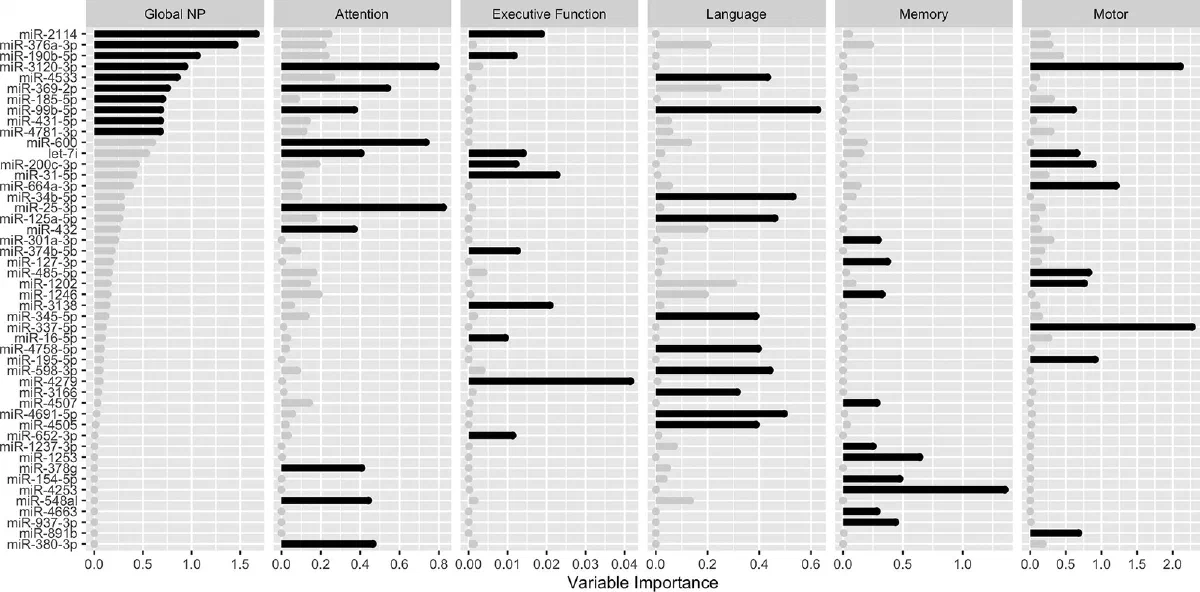
Requests for reprints and correspondences should be addressed to: Leah H. Rubin, Ph.D., MPH, Department of Neurology, Johns Hopkins University School of Medicine, 600 N. Wolfe Street/Meyer 6-113, Baltimore, MD. 21287-7613, Phone: 443-287-0571, Fax: 410-955-0672, lrubin@jhmi.edu. CONTRIBUTORS Dr. Rubin conceived the study idea. Drs. Xu and Yuliang Li conducted the statistical analyses. Drs. Power, Fujiwara, and Gill take responsibility for the ascertainment of the biospecimens and the integrity of the cognitive, behavioral, and clinical data. Drs. Asahchop and Power take responsibility for the miRNA analyses. Dr. Rubin and Julissa Massanett Aparicio wrote the first draft of the manuscript. All authors contributed to the writing of the manuscript and approved the final version. Conflicts of Interest: M.J.G. has served as Ad hoc member on National HIV advisory boards to ViiVhealth, Gilead, and Merck. All other authors declare that they have no conflicts of interest. HHS Public Access Author manuscript AIDS. Author manuscript; available in PMC 2022 September 01. Published in final edited form as: AIDS. 2021 September 01; 35(11): 1795–1804. doi:10.1097/QAD.0000000000002966. Author Manuscript Author Manuscript Author Manuscript Author Manuscript Objective: Cognitive impairment remains common in people with HIV(PWH) on antiretroviral therapy(ART). The clinical presentation and severity is highly variable in PWH suggesting that the pathophysiological mechanisms of cognitive complications are likely complex and multifactorial. MicroRNA(miRNA) expression changes may be linked to cognition as they are gene regulators involved in immune and stress responses as well as the development, plasticity, and differentiation of neurons. We examined plasma miRNA expression changes in relation to domain-specific and global cognitive function in PWH. Design: Cross-sectional observational study Methods: Thirty-three PWH receiving care at the Southern Alberta Clinic, Canada completed neuropsychological(NP) testing and blood draw. Plasma miRNA extraction was followed by array hybridization. Random forest analysis was used to identify the top 10 miRNAs upregulated and downregulated in relation to cognition. Results: Few miRNAs were identified across cognitive domains; however, when evident a miRNA was only associated with two or three domains. Notably, miR-127-3p was related to learning/memory and miR-485-5p to motor function, miRNAs previously identified in CSF or plasma in Alzheimer’s and Parkinson’s, respectively. Using miRNET 2.0, a software-platform for understanding the biological relevance of the miRNA-targets (genes) relating to cognition through a network-based approach, we identified genes involved in signaling, cell cycle, and transcription relating to executive function, learning/memory, and language. Conclusion: Findings support the idea that evaluating miRNA expression (or any molecular measure) in the context of global NP function might exclude miRNAs that could be important contributors to the domain-specific mechanisms leading to the variable neuropsychiatric outcomes seen in PWH.
Publication
Plasma microRNAs are associated with domain-specific cognitive function in people with HIV
Abstract