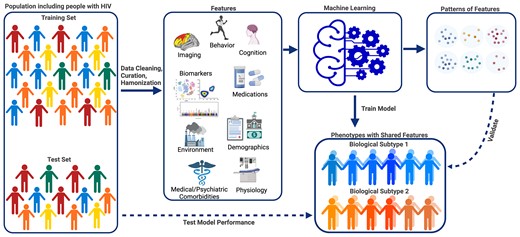
This review is a field-building paper. It explains why cognitive disorders in people with HIV should not be treated as a single uniform outcome, and it lays out what machine learning can and cannot do for cognitive phenotyping. Its value is in connecting methodological choices to the infrastructure the field needs: harmonized data, meaningful metadata, careful confound handling, external validation, and interdisciplinary interpretation.
- The paper reviews machine learning approaches for identifying cognitive phenotypes and biotypes in people with HIV.
- It emphasizes the Research Domain Criteria framework as a way to study mechanisms that cut across traditional diagnostic categories.
- The review highlights the need for common data elements, high-quality longitudinal cohorts, and harmonization across studies.
- It argues that validation, interpretability, and handling of confounds are essential before machine-learning models can inform clinical management.
- The paper positions cognitive phenotyping as a collaborative problem spanning neuropsychology, infectious disease, data science, and computational modeling.
People with HIV can experience different patterns of cognitive change, and those patterns may have different causes. This paper explains how machine learning can help find those patterns, while also warning that algorithms are only useful when the data are well measured, harmonized, and validated. It is less a single-model paper than a roadmap for doing computational cognitive phenotyping responsibly.
AbstractCognitive disorders are prevalent in people with HIV (PWH) despite antiretroviral therapy. Given the heterogeneity of cognitive disorders in PWH in the current era and evidence that these disorders have different etiologies and risk factors, scientific rationale is growing for using data-driven models to identify biologically defined subtypes (biotypes) of these disorders. Here, we discuss the state of science using machine learning to understand cognitive phenotypes in PWH and their associated comorbidities, biological mechanisms, and risk factors. We also discuss methods, example applications, challenges, and what will be required from the field to successfully incorporate machine learning in research on cognitive disorders in PWH. These topics were discussed at the National Institute of Mental Health meeting on “Biotypes of CNS Complications in People Living with HIV” held in October 2021. These ongoing research initiatives seek to explain the heterogeneity of cognitive phenotypes in PWH and their associated biological mechanisms to facilitate clinical management and tailored interventions.