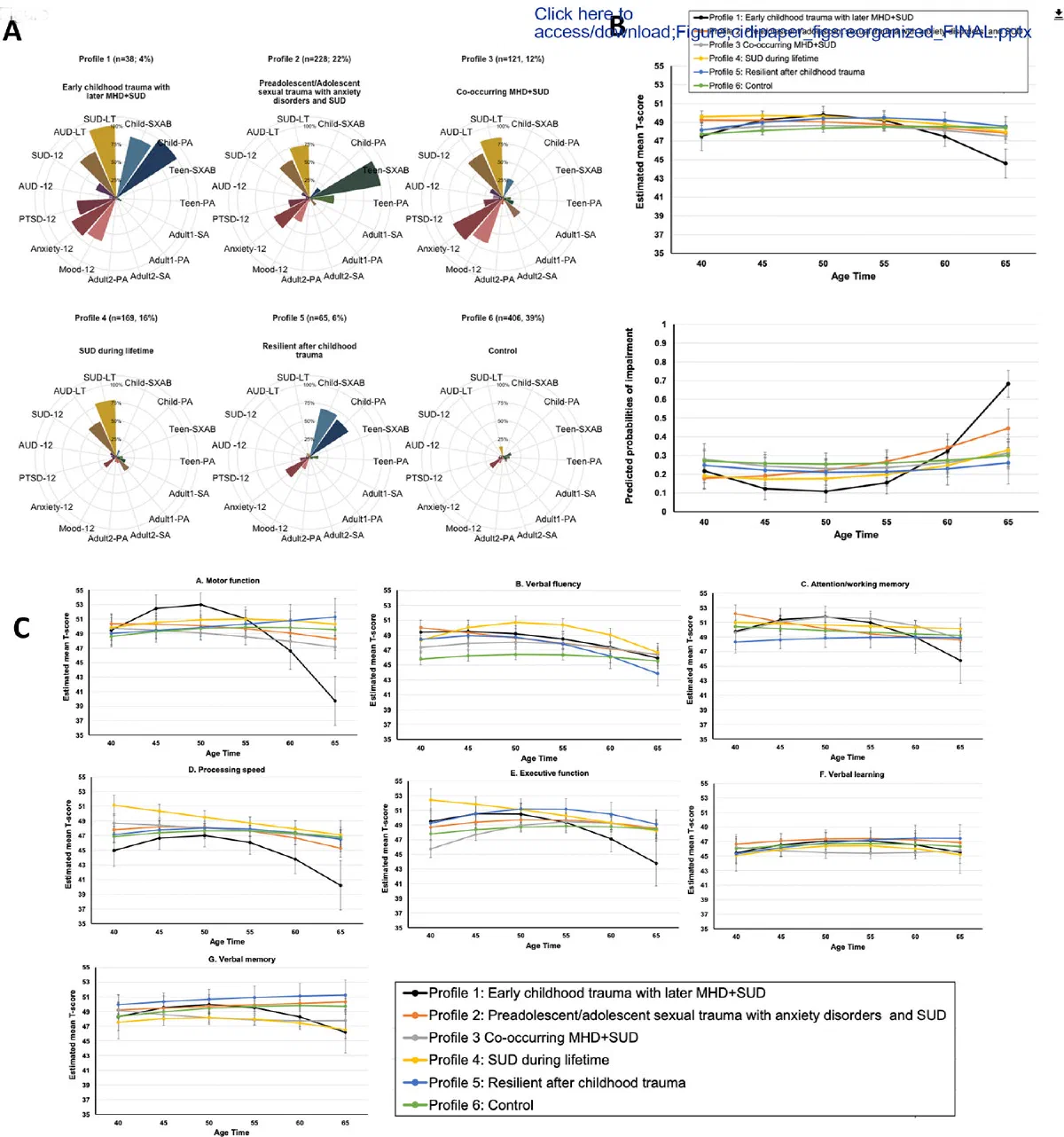
Objective: Sexual and physical abuse are highly prevalent among women living with HIV (WLWH) and are risk factors for development of mental health and substance use disorders (MHDs, SUDs), and cognitive and medical co-morbidities. We examined empirically-derived patterns of trauma, MHD, and SUD, and associations with later cognitive and health outcomes. Requests for reprints and correspondences should be addressed to: Leah H. Rubin, Ph.D., MPH, Department of Neurology, Johns Hopkins University School of Medicine, 600 N. Wolfe Street/Meyer 6-113, Baltimore, MD. 21287-7613, Phone: 443-287-0571, Fax: 410-955-0672, lrubin@jhu.edu. Conflict of Interest: The authors report no conflicts of interest. HHS Public Access Author manuscript Psychosom Med. Author manuscript; available in PMC 2024 May 01. Published in final edited form as: Psychosom Med. 2023 May 01; 85(4): 341–350. doi:10.1097/PSY.0000000000001192. Author Manuscript Author Manuscript Author Manuscript Author Manuscript Methods: 1027 WLWH (average age=48.6 years) in the Women’s Interagency HIV Study completed the World Mental Health-Composite International Diagnostic Interview during 2010– 2013 to identify MHDs, SUDs, and age at onset of sexual and physical abuse. Then, cognitive impairment, cardiovascular/metabolic conditions, and HIV disease outcomes were assessed for up to 8.8 years. Latent class analysis (LCA) identified patterns of co-occurring trauma, MHDs, and/or SUDs. Generalized estimating equations determined associations between these patterns and mid-life cognitive and medical outcomes. Results: Six distinct profiles emerged: no/negligible sexual/physical trauma, MHD, or SUD (39%); preadolescent/adolescent sexual trauma with anxiety and SUD (22%); SUD only (16%); MHD+SUD only (12%); early childhood sexual/physical trauma only (6%); and early childhood sexual/physical trauma with later MHD+SUD (4%). Profiles including early childhood trauma had the largest number of mid-life conditions (i.e., cognitive, cardiovascular, HIV-related). Preadolescent/adolescent sexual trauma with anxiety and SUD predicted both global and domainspecific cognitive decline. Only SUD without trauma predicted lower CD4, while childhood trauma with MHD+SUD predicted increased CD8. Conclusions: WLWH have complex multisystem profiles of abuse, MHD, and/or SUD that predict midlife cognitive, metabolic/cardiovascular, and HIV outcomes. Understanding the interplay between these factors over time can identify risks and personalize preventative and treatment interventions.
Publication
Trauma across the life span and multisystem morbidity in women with HIV
Abstract