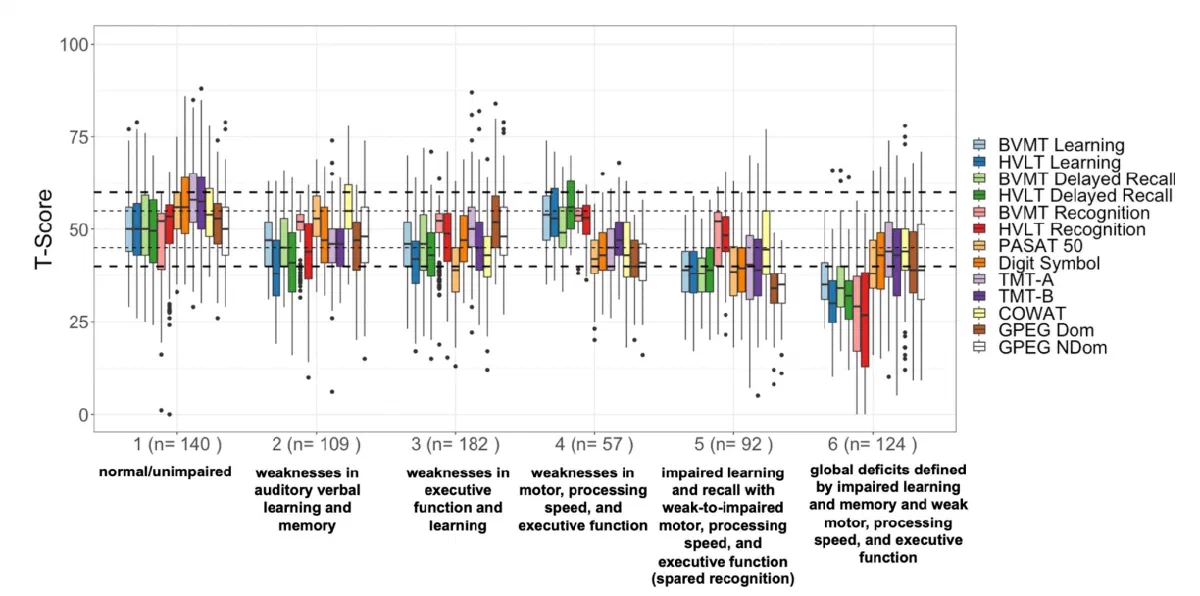
The paper moves beyond the question of whether cognitive impairment is present in people with HIV and asks what forms it takes. That distinction matters for trainees, clinicians, and funders because heterogeneous cognitive profiles imply different mechanisms, different risks, and different intervention targets. The work also shows how dimensionality reduction, clustering, and predictive modeling can make neuropsychological data more interpretable.
- The analysis included 704 virally suppressed people with HIV from the HIV Neurobehavioral Research Program.
- A dimension-reduction and clustering pipeline identified six cognitive profiles: unimpaired, verbal learning and memory weakness, executive function and learning weakness, motor/processing speed/executive weakness, impaired learning and recall with broader weaknesses, and global deficits.
- Learning and memory deficits were common across affected profiles.
- Self-reported mood symptoms and cognitive or functional complaints were the most consistent correlates of profile membership.
- The heterogeneity of profiles supports personalized risk reduction and therapeutic strategies rather than one-size-fits-all cognitive classification.
Even when HIV is virally suppressed, cognitive difficulties do not look the same for everyone. This study grouped people by patterns of neuropsychological performance and found several distinct cognitive profiles. The results suggest that a person’s symptoms, mood, and day-to-day functional complaints can help interpret which kind of cognitive pattern they may be experiencing.