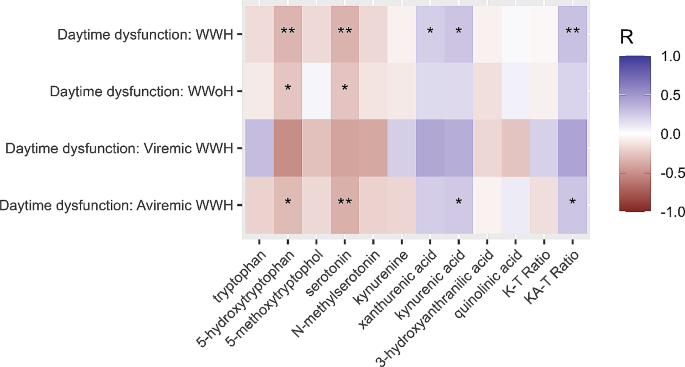
Sleep disturbances are prevalent in women with HIV (WWH). Tryptophan-kynurenine (T-K) pathway metabolites are asso ciated with alterations in actigraphy derived sleep measures in WWH, although may not always correlate with functional impairment. We investigated the relationship between T-K pathway metabolites and self-reported daytime dysfunction in WWH and women without HIV (WWoH). 141 WWH on stable antiretroviral therapy and 140 demographically similar WWoH enrolled in the IDOze Study had targeted plasma T-K metabolites measured using liquid chromatography-tandem mass spectrometry. We utilized the daytime dysfunction component of the Pittsburgh Sleep Quality Index (PSQI) to assess functional impairment across HIV-serostatus. Lower levels of 5-hydroxytryptophan and serotonin were associated with greater daytime dysfunction in all women. In WWH, daytime dysfunction was associated with increased kynurenic acid (R = 0.26, p < 0.05), and kynurenic acid-tryptophan (KA-T) ratio (R = 0.28, p < 0.01). WWH with daytime dysfunction had a 0.7 log fold increase in kynurenic acid compared to WWH without daytime dysfunction. Kynurenic acid levels and the KA-T ratio were associated with daytime dysfunction in WWH but not in WWoH. Longitudinal studies are needed to establish a causal relationship and directionality between T-K metabolic changes and sleep impairment in WWH.
Publication
Tryptophan-kynurenine metabolic pathway and daytime dysfunction in women with HIV
Abstract