Digital cognitive testing is becoming central to large cohort studies, but interpretation depends on norms that reflect the population being studied. This BRACE paper turns an iPad-based cognitive screener into a more useful research instrument by deriving regression-based norms in MACS/WIHS participants without HIV who were comparable to participants with HIV. For collaborators and reviewers, the importance is practical: the work makes cognitive scores more interpretable across age, education, HIV status, and biological sex in a large, diverse cohort.
- The study analyzed BRACE performance from 2,937 MACS/WIHS Combined Cohort Study participants, including 1,063 people without HIV and 1,874 people with HIV.
- BRACE measured performance on tablet-based Trail Making, Stroop-Color, and Visual-Spatial Learning tasks.
- Regression-based norms were derived from people without HIV; an age-plus-education model was selected to support generalizable interpretation without race-based correction.
- Cognitive performance was largely comparable between people with and without HIV; statistically significant differences were small in magnitude.
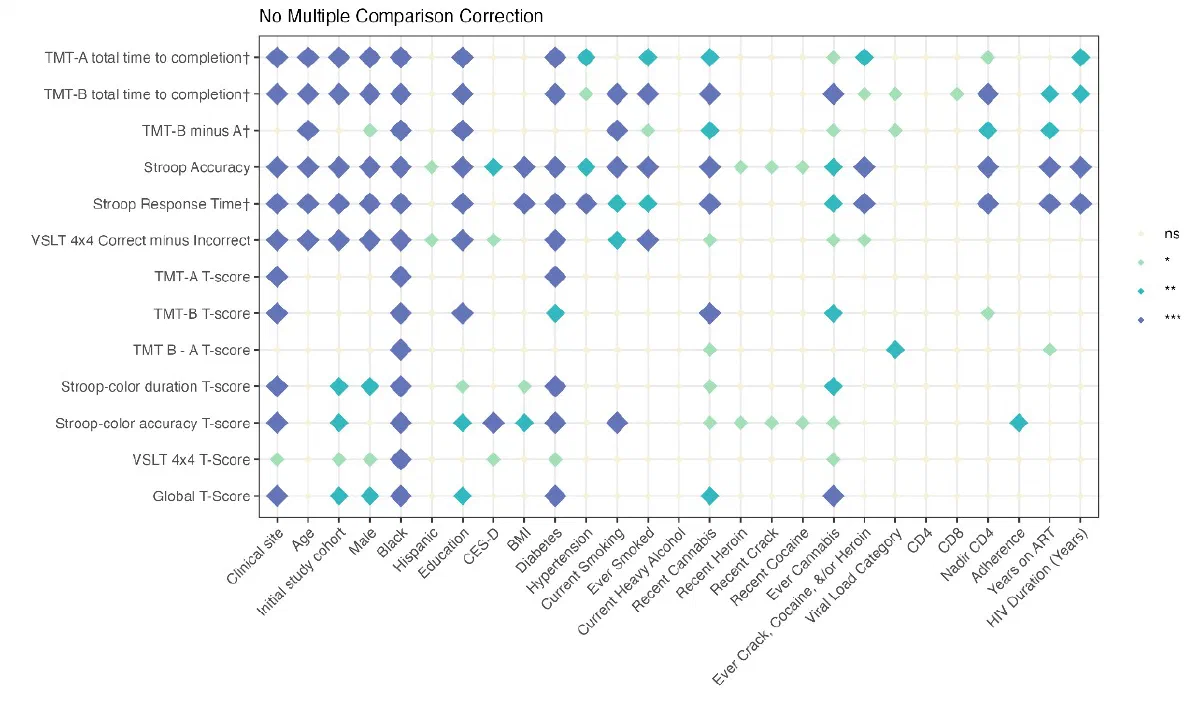
- Age, education, diabetes, and cannabis use were more informative for BRACE performance than many HIV-specific clinical variables after standardization.
BRACE is an iPad-based way to measure cognitive performance. This paper asks how BRACE scores should be interpreted in a large HIV cohort, rather than treating raw scores as self-explanatory. By creating norms from demographically comparable people without HIV, the study gives researchers a clearer baseline for evaluating cognition in people with HIV and for following cognitive health over time.
Background: Digital cognitive assessments are increasingly used in large-scale studies to assess brain health, offering scalable, standardized, and self-directed testing solutions. Cognitive function remains a concern for people with HIV (PWH) despite antiretroviral therapy. The BrainBaseline Assessment of Cognition and Everyday Functioning (BRACE) is a validated tabletbased screener for cognition in PWH. Preliminary pilot norms were established in a small sample (n=144), but full regressionbased normative data have not been developed. Consequently, HIV serostatus differences based on standardized BRACE scores and cognitive correlates have not been systematically examined. Objective: To develop regression-based normative data for BRACE performance in people without HIV (PWoH) who were demographically and behaviorally comparable to PWH within biological sex; to examine differences in cognitive performance by HIV status and biological sex; and to evaluate sociodemographic, behavioral, and clinical correlates of BRACE performance. Methods: A total of 2,937 participants (1063 PWoH [499 women] and 1,874 PWH [1,053 women]) in the Multicenter AIDS Cohort Study/Women’s Interagency HIV Study Combined Cohort Study completed BRACE once between November 2020 and March 2025. BRACE includes Trail Making Test (A&B), Stroop-Color, and Visual-Spatial Learning. Regression-based norms were derived from PWoH using multiple demographic models (e.g., age-only, age+education, age+education+sex). The age+education model was selected for primary analyses to maximize generalizability and avoid race-based corrections. HIV serostatus and sex differences were examined using analysis of variance and chi-square tests, with effect sizes calculated using Cohen’s d. Results: Cognitive performance was largely comparable between PWH and PWoH across all BRACE outcome measures. https://preprints.jmir.org/preprint/70207 [unpublished, peer-reviewed preprint]