This paper connects social determinants of health to biological pathways and cognitive aging. Rather than studying income, employment, metabolites, and memory as separate domains, it tests whether metabolomic levels partially mediate the relationship between socioeconomic conditions and changes in declarative memory. For funders and collaborators, the study is a strong example of translational data science: social context, molecular measurement, and longitudinal cognition are analyzed in one framework.
- The analysis included 324 women from the Women’s Interagency HIV Study, including 225 women with HIV.
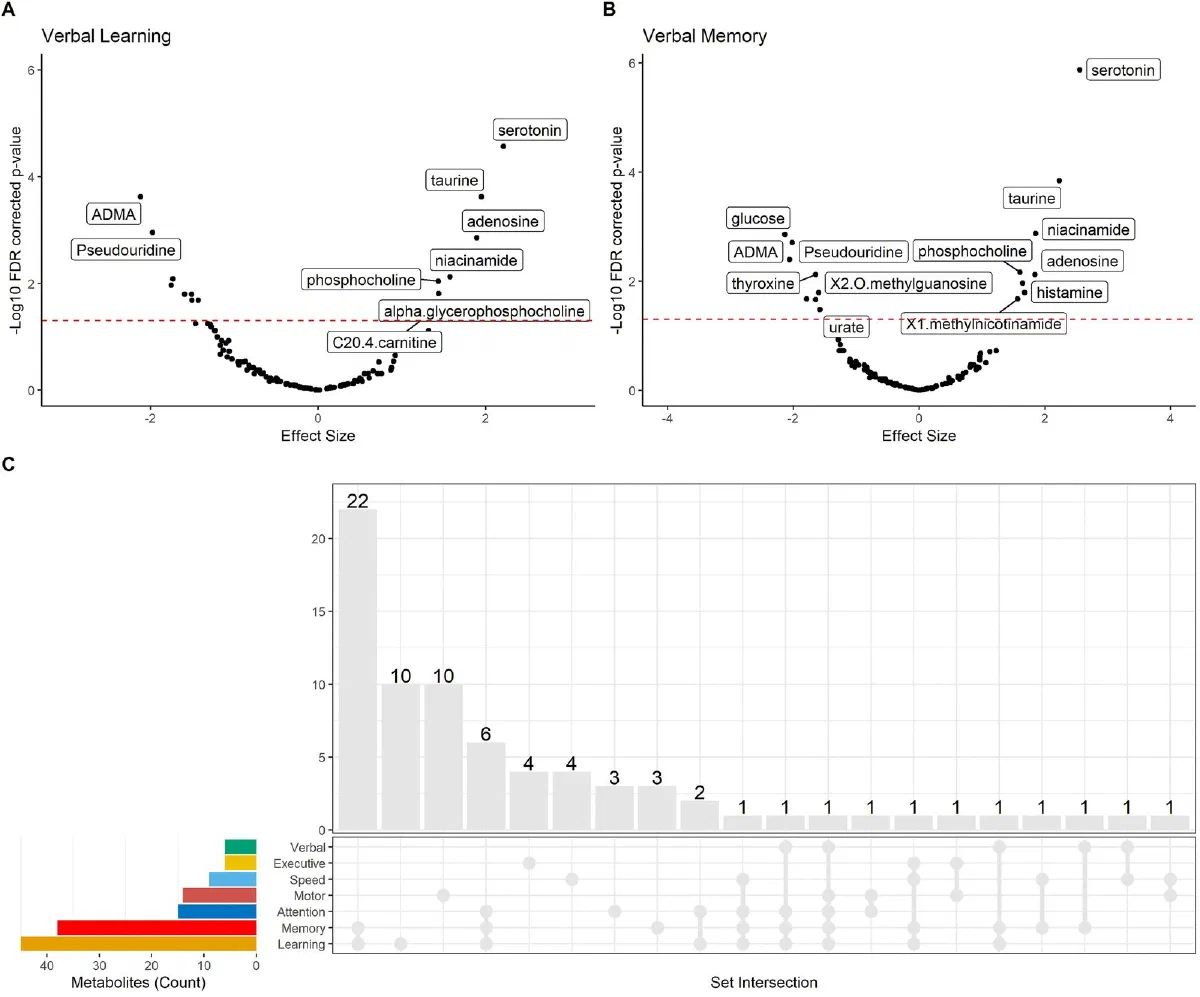
- Fifteen metabolites were associated with longitudinal learning change and 16 with memory change after false-discovery-rate correction.
- Top metabolites included serotonin, taurine, and niacinamide.
- Observed effect sizes were generally similar by HIV serostatus.
- Mediation analyses suggested that metabolite levels explained part of the relationship between employment, income, and learning change.
This study asks how social and economic conditions may become biologically embedded in ways that affect memory over time. In a cohort of women with and without HIV, the authors found metabolites related to changes in learning and memory. Some of those metabolite patterns helped explain links between employment, income, and memory performance.