Research Thread

Computational Phenotyping

Finding hidden cognitive and clinical structure in complex human data.
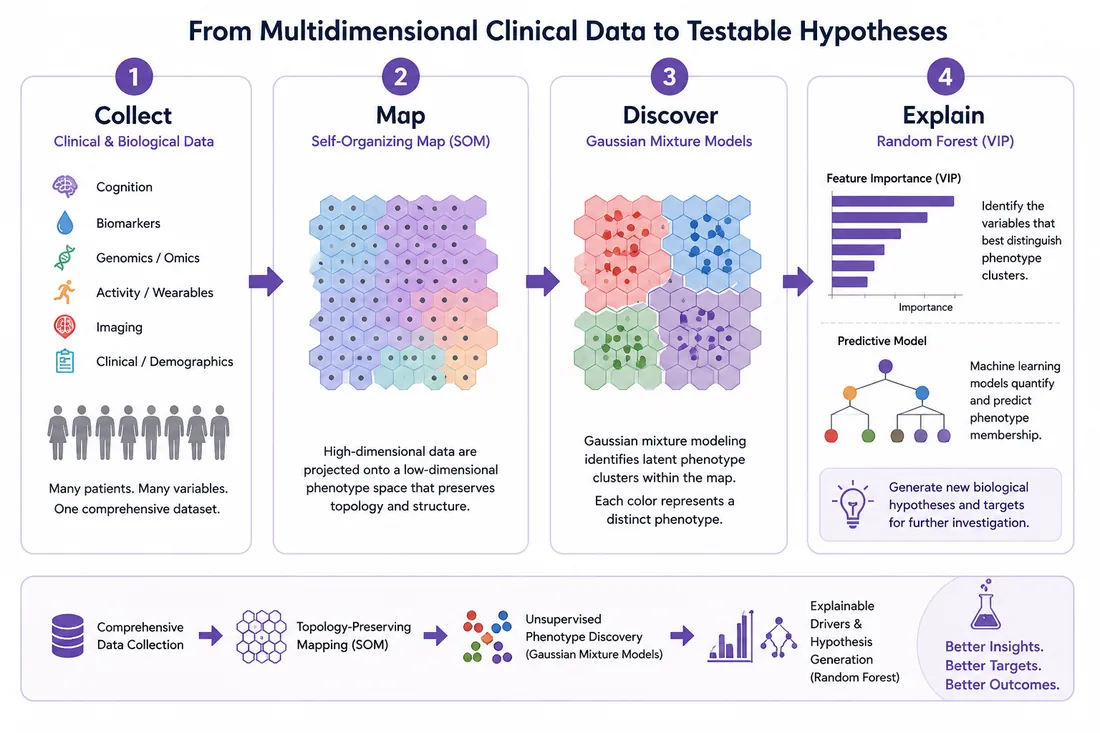
Pipeline diagram from multidimensional clinical data collection through self-organizing maps, Gaussian mixture model phenotype discovery, and random forest explanation.

This thread focuses on discovering interpretable patterns in heterogeneous cognitive, behavioral, clinical, and biomarker data. The goal is to move beyond average effects and toward profiles that can generate hypotheses, clarify mechanisms, and support more precise translational questions.

Scientific Question

How can high-dimensional cognitive and clinical data reveal meaningful subgroups rather than average effects?
Connected Publications
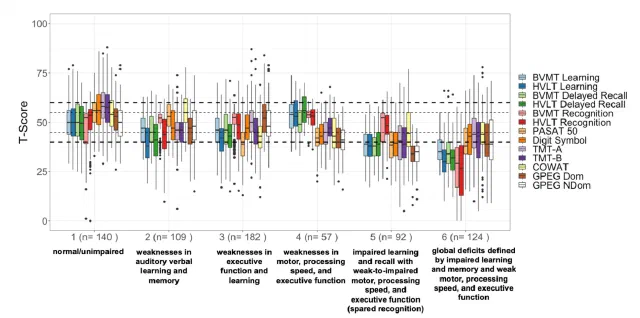
Publication preview for Identifying and distinguishing cognitive profiles among virally suppressed people with HIV.
2024 article highlighted

Identifying and distinguishing cognitive profiles among virally suppressed people with HIV.

Erin E. Sundermann, Raha Dastgheyb, David J. Moore, Alison S. Buchholz, Mark W. Bondi, Ronald J. Ellis, Scott L. Letendre, Robert K. Heaton, Leah H. Rubin

Neuropsychology

Identifies six cognitive profiles among virally suppressed people with HIV and the factors that distinguish them.
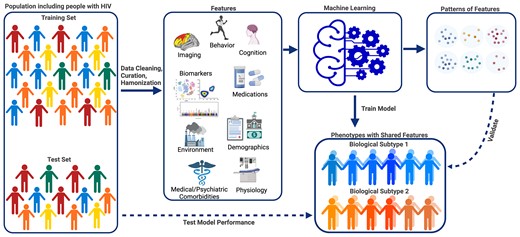
Figure from Machine learning approaches to understand cognitive phenotypes in people with HIV
2023 article highlighted

Machine learning approaches to understand cognitive phenotypes in people with HIV

Shibani S. Mukerji, Kalen J. Petersen, Kilian M. Pohl, Raha M. Dastgheyb, Howard S. Fox, Robert M. Bilder, Marie-Josée Brouillette, Alden L. Gross, Lori A. J. Scott-Sheldon, Robert H. Paul, Dana Gabuzda

The Journal of infectious diseases

Frames machine learning as a tool for discovering cognitive biotypes in people with HIV.
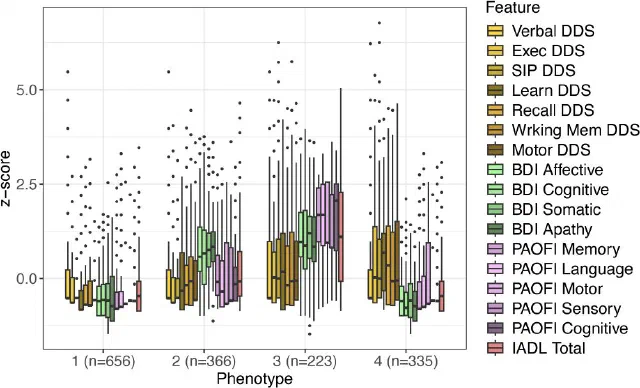
Figure from Biopsychosocial phenotypes in people with HIV in the CHARTER cohort
2024 article selected

Biopsychosocial phenotypes in people with HIV in the CHARTER cohort

Bin Tang, Ronald J. Ellis, Florin Vaida, Anya Umlauf, Donald R. Franklin, Raha Dastgheyb, Leah H. Rubin, Patricia K. Riggs, Jennifer E. Iudicello, David B. Clifford, David J. Moore, Robert K. Heaton, Scott L. Letendre

Brain Communications

This paper helps define a research thread in computational phenotyping and cognitive subgroup discovery, providing context for how computational and translational evidence can be organized into reusable scientific systems.

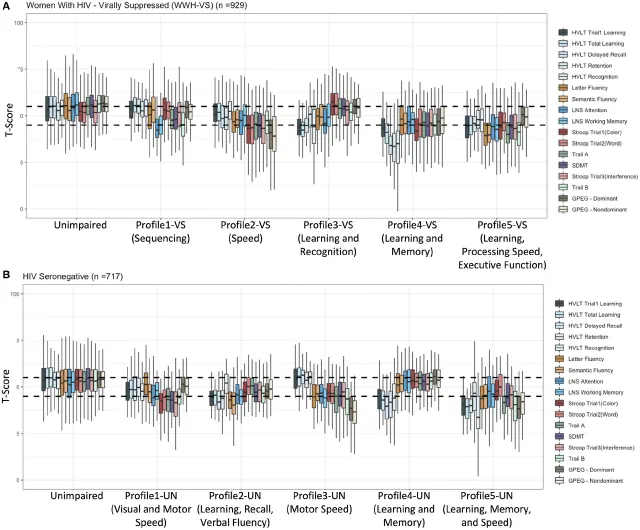
Figure from Patterns and predictors of cognitive function among virally suppressed women with HIV
2021 article highlighted

Patterns and predictors of cognitive function among virally suppressed women with HIV

Raha M. Dastgheyb, Alison S. Buchholz, Kathryn C. Fitzgerald, Yanxun Xu, Dionna W. Williams, Gayle Springer, Kathryn Anastos, Deborah R. Gustafson, Amanda B. Spence, Adaora A. Adimora, Drenna Waldrop, David E. Vance, Joel Milam, Hector Bolivar, Kathleen M. Weber, Norman J. Haughey, Pauline M. Maki, Leah H. Rubin

Frontiers in neurology

Uses self-organizing maps and random forests to characterize cognitive profiles in virally suppressed women with HIV.

Related Talks